I told you about my frozen shoulder a few entries back and that doing the exercises to loosen it were excruciating but helpful, though they did not entirely solve the problem. Well getting in the pool and doing the backstroke in cool water did.
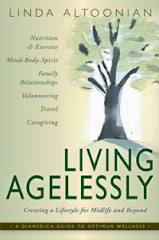
In fact, working out in the pool is really magical. Now, I'm no Esther Williams, so I'm not doing laps for 45 minutes, but I keep moving hard for that long so my heart rate stays up and I'm breathing deeply (I refer to the amazing benefits of deep breathing in my book Living Agelessly and give lots of exercises.).
Then I do 15 minutes of isometric exercises and stretches in the shallow end. Afterwards, I float on the water and just relax deeply. I feel so good that it's like having been to a spa, and I always sleep well that evening.
Water workouts are particularly good for us because we eliminate the abuse to our joints and for those who suffer with Osteoarthritis, it's the perfect way to exercise without exacerbating wear and tear. Those who suffer with muscle pain should also avoid high impact activities. Gentle but invigorating exercises improve muscle tone and strength, and it's the perfect way to exercise for those who are overweight.
The following are more benefits as outlined on iloveindia.com.
Provides Buoyancy
One of the major benefits of water aerobics is that it provides buoyancy and support for the body, making it less likely for the muscle, bone and joint to get injured. Water supports upto 80% of your weight, thereby causing less strain on the joints, back and torso, when compared to exercises performed on land.
Quick Muscular Endurance
The high density of water, as compared to air, leads to increased resistance, thereby augmenting muscular endurance and tone. This means that water aerobics builds-up toned and endured muscle mass all around the body. Also, one tends to get quicker results exercising in the water, than on land.
Improved Flexibility
The reduced effect of gravitational force in water leads to improved flexibility in the body. The joints can be easily moved through a wider range of motion, which makes water aerobics all the more beneficial as we age. Since there is no joint pain caused, you can perform the exercise without any kind of anxiety.
Improve Cardiovascular Conditioning
Water aerobics exercises prove to be extremely beneficial in terms of cardiovascular conditioning. In such an exercise, the heart rate is maintained at a lower rate, when compared to cycling or running. The heart seems to work better when you indulge in water aerobics.
Helps Keep Cool
The 'cool' quotient cannot be ruled out when we talk about the benefits of water aerobics. It is refreshing activity and lifts up the mood instantly. It keeps the body temperature constant throughout the exercise. Also, water keeps you cool and comfortable, even when the mercury is rising.
Burn Calories
We all know that exercising is the best way to get rid of those bulging fats and ever-increasing waistlines. However, do you know that water aerobics are more effective, as compared to land exercises? The former leads to a loss of about 450 to 700 calories per hour. So, if you want to shed those extra kilos, water aerobics can be extremely useful.
When I work out, I don't use any apparatus, but if you want to, visit http://www.waterworkout.com/ for things like aqua shoes, aqua barbells, webbed gloves, flotation belts, power paddles, and water workout DVDs including one called Aqua Latin Rhythms that I found intriguing because I love to dance and hate to sweat, so what could be better than dancing in the water.
Just dive in folks. The water is really fine!
Saturday, June 12, 2010

Saturday, June 5, 2010
Don't You Be Weak in the Knees
I played soccer in junior high, basketball in high school, and I've been dancing since I could walk. I loved every minute, but I'm paying for it now with my knees, and since knee surgery to repair a torn ligament, arthritis has set in big time. Aging and weight gain have also had an impact.
More than 20 million Americans suffer with osteoarthritis (OA), the number one cause of disability in the United States. OA strikes three times as many women as men and most often occurs in people over 50. However younger people who have been injured in sports or accidents can start having symptoms in their 20s and 30s.
OA is a chronic disease, and it will never get better (YUK!). In fact, because the knee pain and immobility are caused by wear and tear between the joints, the symptoms will worsen overtime (YUK! YUK!). Symptoms include pain, stiffness, swelling and inflammation of affected joints and are more prominent after activity (including walking, driving, lifting, standing, bending and climbing), but pain and stiffness can be experienced after resting too, particularly in the morning. OA sufferers also report gaining an average of 42 pounds after diagnosis because they cannot exercise as much, and they often lose two to three hours of sleep at night because of the pain.
In addition to physical symptoms, osteoarthritis takes an emotional toll as well. OA changes lifestyle forever, impacts relationships and the ability to work and be active, and those kind of losses cause depression.
Because of the pain, the tendency is become more inactive, but that will worsen the problem. It is true that if you don't move it, you will lose it. You may not be able to jog any more or even use the treadmill, but you can and should ride a bike and work out in a pool.
Regular exercise will strengthen the muscles around those joints, increase flexibility and blood flow to the affected area, in addition to helping you lose weight. Lightening the load will lessen the pressure on those weight bearing joints, diminish more wear and tear, and decrease inflammation and pain. When, not if, the pain becomes really difficult, medication and injecting steroids can help.
Well, I did all that but still struggled with my knee collapsing, so I took another step as well. My orthopedic physician suggested injections of ultra-pure hyaluronan--which is naturally found in healthy joint fluid. Given as one injection for three consecutive weeks, the protocol helps restore healthy joint fluid to cushion, protect and lubricate the knee joint. It can relieve knee pain for up to six months. In my case, relief lasted an entire year.
The most dramatic course of action is surgery but take care with that decision. I've heard stories of great successes but also terrible nightmares. Seek out a great orthopedic physician for x-rays of your joints and to discuss what options are best for you.
And keep moving. Don't let OA win!
More than 20 million Americans suffer with osteoarthritis (OA), the number one cause of disability in the United States. OA strikes three times as many women as men and most often occurs in people over 50. However younger people who have been injured in sports or accidents can start having symptoms in their 20s and 30s.
OA is a chronic disease, and it will never get better (YUK!). In fact, because the knee pain and immobility are caused by wear and tear between the joints, the symptoms will worsen overtime (YUK! YUK!). Symptoms include pain, stiffness, swelling and inflammation of affected joints and are more prominent after activity (including walking, driving, lifting, standing, bending and climbing), but pain and stiffness can be experienced after resting too, particularly in the morning. OA sufferers also report gaining an average of 42 pounds after diagnosis because they cannot exercise as much, and they often lose two to three hours of sleep at night because of the pain.
In addition to physical symptoms, osteoarthritis takes an emotional toll as well. OA changes lifestyle forever, impacts relationships and the ability to work and be active, and those kind of losses cause depression.
Because of the pain, the tendency is become more inactive, but that will worsen the problem. It is true that if you don't move it, you will lose it. You may not be able to jog any more or even use the treadmill, but you can and should ride a bike and work out in a pool.
Regular exercise will strengthen the muscles around those joints, increase flexibility and blood flow to the affected area, in addition to helping you lose weight. Lightening the load will lessen the pressure on those weight bearing joints, diminish more wear and tear, and decrease inflammation and pain. When, not if, the pain becomes really difficult, medication and injecting steroids can help.
Well, I did all that but still struggled with my knee collapsing, so I took another step as well. My orthopedic physician suggested injections of ultra-pure hyaluronan--which is naturally found in healthy joint fluid. Given as one injection for three consecutive weeks, the protocol helps restore healthy joint fluid to cushion, protect and lubricate the knee joint. It can relieve knee pain for up to six months. In my case, relief lasted an entire year.
The most dramatic course of action is surgery but take care with that decision. I've heard stories of great successes but also terrible nightmares. Seek out a great orthopedic physician for x-rays of your joints and to discuss what options are best for you.
And keep moving. Don't let OA win!
Saturday, May 29, 2010
Eat Fruit to Reverse Aging
Doctors all agree eating fruit is critical for a healthy diet. Some believe fruit is important for detoxifying the body, increasing energy, and reducing the inflammation the causes aging and ravages our faces--specifically resulting in wrinkles and dull skin.
It turns out there are important rules to follow when you eat them:
Eat your fruit first, and you will avoid bloating, burping and gas. It has even been suggested that if you eat fruits on an empty stomach, you will forestall balding, gray hair and dark circles under the eyes, and that we may even impact our longevity and energy level, and create a healthy weight. What have we got to lose? Oh yes..maybe those extra pounds some of us are carrying around.
You can begin a new fruit regimen with a three-day fruit fast to cleanse your body. Just eat fruits and drink fruit juice, and you will feel and look better. As with ALL dietary changes, however, consult with your physician before trying anything new.
Check my book Living Agelessly for a more complete list of fruits that pack a punch.
Fruit Salad
It turns out there are important rules to follow when you eat them:
- Eating whole fruit is better than drinking juice. There are lots of nutrients in the skin.
- Drink only fresh fruit juice, not canned. Canned drinks are high in calories and preservatives.
- Don't eat cooked fruits because you don't get any nutrients.
- Don't drink juice that has been heated for the same reason.
- If you do drink fresh juice, drink it one mouthful at a time so your saliva mixes with it.
- Eat fruits on an empty stomach.
- Eat fruits at the start of the meal, never after.
Eat your fruit first, and you will avoid bloating, burping and gas. It has even been suggested that if you eat fruits on an empty stomach, you will forestall balding, gray hair and dark circles under the eyes, and that we may even impact our longevity and energy level, and create a healthy weight. What have we got to lose? Oh yes..maybe those extra pounds some of us are carrying around.
You can begin a new fruit regimen with a three-day fruit fast to cleanse your body. Just eat fruits and drink fruit juice, and you will feel and look better. As with ALL dietary changes, however, consult with your physician before trying anything new.
Check my book Living Agelessly for a more complete list of fruits that pack a punch.
- Berries are best. They are great antioxidants and result in radiant skin. Strawberries in particular protect the body from cancer-causing, blood vessel-clogging free radicals.
- Kiwi is a good source of vitamin E, potassium and magnesium. Great for fiber, this little fruit has twice the Vitamin C as an orange.
- An apple also has antioxidants and lowers the risk of heart attack, stroke and colon cancer.
- Oranges really do keep colds at bay, lower cholesterol and lessen the risk of colon cancer.
- Watermelon is a source of potassium and Vitamin C, boosts the immune system and fights cancer.
- Guava and papaya have the highest source of Vitamin C. They are rich in fiber, which helps prevent constipation, and the carotene that is good for the eyes.
Fruit Salad
- Slice strawberries, grapes, bananas into a bowl.
- Add chopped walnuts.
- Mix in vanilla yogurt and serve.
- Slice green apples with skin into very thin slices.
- Mix cinnamon into vanilla yogurt and let the dipping begin.
Sunday, May 23, 2010
Life Saving Tests
According to the American Heart Association, we should seriously consider undergoing a vascular and/or cardiovascular screening. Both are painless procedures that can predict our risk for developing coronary heart disease within the next ten years.
A vascular screening, which takes only 15 minutes, includes an ultrasound of the neck and abdominal arteries and a Doppler measurement of the arteries in our ankles. A cardiovascular screening, which takes only 20 minutes, is more in depth. It includes a cardiac health history, a physical examination with blood pressure check and glucose and cholesterol blood tests, an electrocardiogram, and a personal Framingham Risk Assessment to determine our risk for having Cardio Vascular Disease (CVD).
CVD is the number one cause of death in the nation. In fact, more than 80 million people in the United States have one or more forms, and some of us are at greater risk for the disease. Be concerned if you are a man over 45 or a woman over 55 and have diabetes, high blood pressure or cholesterol, a family history of heart disease or stroke, or if you smoke.
The danger of developing CVD increases with age and early detection is critical. A vascular or cardiovascular screening is the best way to determine the extent of your risk, and what you find out might be just the motivation you need to make important lifestyle changes to prevent a stroke, a heart attack, or heart failure that can result in your death.
Contact the American Heart Association at 1-800-AHA-USA1 for more information.
A vascular screening, which takes only 15 minutes, includes an ultrasound of the neck and abdominal arteries and a Doppler measurement of the arteries in our ankles. A cardiovascular screening, which takes only 20 minutes, is more in depth. It includes a cardiac health history, a physical examination with blood pressure check and glucose and cholesterol blood tests, an electrocardiogram, and a personal Framingham Risk Assessment to determine our risk for having Cardio Vascular Disease (CVD).
CVD is the number one cause of death in the nation. In fact, more than 80 million people in the United States have one or more forms, and some of us are at greater risk for the disease. Be concerned if you are a man over 45 or a woman over 55 and have diabetes, high blood pressure or cholesterol, a family history of heart disease or stroke, or if you smoke.
The danger of developing CVD increases with age and early detection is critical. A vascular or cardiovascular screening is the best way to determine the extent of your risk, and what you find out might be just the motivation you need to make important lifestyle changes to prevent a stroke, a heart attack, or heart failure that can result in your death.
Contact the American Heart Association at 1-800-AHA-USA1 for more information.
Saturday, May 15, 2010
What's Happening in Our Schools?
The end of the school year is a crazy time for teachers! Exams, final grades, trips and banquets make up the "millions" of details and events that must be attended to before that final bell.
The journalism department in my school just celebrated a year's worth of work with a banquet. It was a catered affair for which the students donned their prettiest clothes and best behavior. During the evening, I recognized the numerous awards that my students won on a national and state level with compliments, certificates, and encouragement to aspire to even higher levels of achievement for after graduation, if they were seniors, and for the coming year, if they were underclassmen.
It is easy for me to honor my students. For the most part, they are truly the cream of the crop--academically gifted, hardworking, self-motivated, ethical and respectful. They most certainly give me hope for the future, and they are really the reason why I still teach when I don't have to. My worry is that they are not representative. They are the exception.
America was once number one is the world with regard to educational achievement. We have dropped to 27th, well behind China and India. We are no longer the best and the brightest. In fact, we are struggling to stay in the race. The problem is even more magnified when I have foreign exchange students in my class; they speak and write ENGLISH better than my American born students. What has happened?
We have lost the middle class student--that strong B/C student who may or not have gone to college, but who would have become a strong, contributing part of society. We now have the exceptional student (and a far smaller group of them) and all the rest, who are disenchanted, discontented and disengaged.
They act out, choose badly, and don't have a clue what they are going to do in the future. They are disrespectful to the adults in their life. They are irresponsible, and they don't care about anything that's important, and the problem is terrifying to me both as a teacher and as a citizen who will be aged when these students will be making the decisions that impact me, my family and my country.
What makes the difference in kids? My fabulous students come from involved families that have very high expectations for their behavior and their achievements. Those students generally work in the real world too where they learn appropriate adult behavior and advanced skills, and they are busy with constructive school and church activities that encourage their talents, strengths and value systems. Even if these students wanted to engage in risky behavior, they don't have time, and they know that there would be severe consequences if they did.
There's the key--families that care and are involved in their children's lives; parents and grandparents who model and expect exceptional behavior and achievement, and activities that keep students accountable. All that should begin when children are born and be sustained throughout their lives. It's too late to fix substantive problems in high school or college. Prevention begins with good parenting.
The school system should not be adhering to the "No Child Left Behind" theory if we're passing students who haven't earned the right and appropriate education to move forward. It doesn't help them or our society to graduate students without the necessary skills to become productive. Not everyone should go to college, but all should have a skill set that can allow for success.
Parents shouldn't expect the school system to give their children a pass if they break the rules, and we should ALL be raising the bar, not lowering it, on expectations for our children to work harder, learn more, and behave in a way that makes us proud.
America needs this generation of students to do better and be better or we are in serious trouble.
To the exceptional students, whom I'm blessed to have, I thank you for your moving tribute to me at the banquet, and for being my hope for the future. You have a greater burden than any generation before you, though. You have the lion's share of the job to put America back on the right road. I wish you strength and wisdom to accomplish the task.
The journalism department in my school just celebrated a year's worth of work with a banquet. It was a catered affair for which the students donned their prettiest clothes and best behavior. During the evening, I recognized the numerous awards that my students won on a national and state level with compliments, certificates, and encouragement to aspire to even higher levels of achievement for after graduation, if they were seniors, and for the coming year, if they were underclassmen.
It is easy for me to honor my students. For the most part, they are truly the cream of the crop--academically gifted, hardworking, self-motivated, ethical and respectful. They most certainly give me hope for the future, and they are really the reason why I still teach when I don't have to. My worry is that they are not representative. They are the exception.
America was once number one is the world with regard to educational achievement. We have dropped to 27th, well behind China and India. We are no longer the best and the brightest. In fact, we are struggling to stay in the race. The problem is even more magnified when I have foreign exchange students in my class; they speak and write ENGLISH better than my American born students. What has happened?
We have lost the middle class student--that strong B/C student who may or not have gone to college, but who would have become a strong, contributing part of society. We now have the exceptional student (and a far smaller group of them) and all the rest, who are disenchanted, discontented and disengaged.
They act out, choose badly, and don't have a clue what they are going to do in the future. They are disrespectful to the adults in their life. They are irresponsible, and they don't care about anything that's important, and the problem is terrifying to me both as a teacher and as a citizen who will be aged when these students will be making the decisions that impact me, my family and my country.
What makes the difference in kids? My fabulous students come from involved families that have very high expectations for their behavior and their achievements. Those students generally work in the real world too where they learn appropriate adult behavior and advanced skills, and they are busy with constructive school and church activities that encourage their talents, strengths and value systems. Even if these students wanted to engage in risky behavior, they don't have time, and they know that there would be severe consequences if they did.
There's the key--families that care and are involved in their children's lives; parents and grandparents who model and expect exceptional behavior and achievement, and activities that keep students accountable. All that should begin when children are born and be sustained throughout their lives. It's too late to fix substantive problems in high school or college. Prevention begins with good parenting.
The school system should not be adhering to the "No Child Left Behind" theory if we're passing students who haven't earned the right and appropriate education to move forward. It doesn't help them or our society to graduate students without the necessary skills to become productive. Not everyone should go to college, but all should have a skill set that can allow for success.
Parents shouldn't expect the school system to give their children a pass if they break the rules, and we should ALL be raising the bar, not lowering it, on expectations for our children to work harder, learn more, and behave in a way that makes us proud.
America needs this generation of students to do better and be better or we are in serious trouble.
To the exceptional students, whom I'm blessed to have, I thank you for your moving tribute to me at the banquet, and for being my hope for the future. You have a greater burden than any generation before you, though. You have the lion's share of the job to put America back on the right road. I wish you strength and wisdom to accomplish the task.
Saturday, May 8, 2010
Happy Mother's Day to Single Moms!
Mothers are extraordinary creatures. They cherish their children and think of little besides their security, contentment and success, put their own desires on hold, and give all that is humanly possible. They sacrifice the bodies of their youth and a simple life of self-centered pursuits.
Regardless of the constant work, exhaustion and worry, mothers still invest every ounce of their energy and emotion into the job of raising their children. The rewards for their self-sacrifice are gray hair, guilt about not doing the job perfectly, being taken for granted, and, ultimately, an empty nest.
Ironically, if asked to do it again, most would do so in a heartbeat--their baby's goodnight kisses, toddler's small hand in theirs, and teenager's laughter and excitement at life's unfolding, all sweet compensation.
Single moms have a particularly tough road, especially if they don't have family help. Often they have to work in addition to full time mothering and home keeping, and some have to work two jobs. They have to be mother and father, offering both the soft shoulder and necessary boundaries, and they can't play Disneyland Dad because their kids must stay grounded and secure.
They walk a delicate line--how to protect their children and when to allow them to experience truth, and unlike Disneyland Dad, who is often treated with kid gloves, the single mom must absorb the negative feelings that her children are likely to have as the result of divorce. She is the easy target because the children know she will always be there for them.
Single mothers are particularly amazing--true unsung heroes. Without showing the fear that often darkens their world, they must find the strength, endurance and courage to carry out their awesome responsibility alone and in an environment that is complicated, costly, unsupportive and even hostile.
There is help, however. Read The Single Mother's Book: A Practical Guide to Managing Your Children, Career, Home, Finances and Everything Else by Joan Anderson (Peachtree Publishers) and Going It Alone: Meeting the Challenges of Being a Single Mom by Michele Howe (Hendrickson Publishers). Visit www.singlemothers.org, www.parenting.ivillage.com, and www.singleparents.about.com for excellent resources, information and support while accomplishing nobly the most important job of all.
Take time to celebrate, single moms. You've earned it and even if your children don't understand or even appreciate all you've done yet, one day they will.
Regardless of the constant work, exhaustion and worry, mothers still invest every ounce of their energy and emotion into the job of raising their children. The rewards for their self-sacrifice are gray hair, guilt about not doing the job perfectly, being taken for granted, and, ultimately, an empty nest.
Ironically, if asked to do it again, most would do so in a heartbeat--their baby's goodnight kisses, toddler's small hand in theirs, and teenager's laughter and excitement at life's unfolding, all sweet compensation.
Single moms have a particularly tough road, especially if they don't have family help. Often they have to work in addition to full time mothering and home keeping, and some have to work two jobs. They have to be mother and father, offering both the soft shoulder and necessary boundaries, and they can't play Disneyland Dad because their kids must stay grounded and secure.
They walk a delicate line--how to protect their children and when to allow them to experience truth, and unlike Disneyland Dad, who is often treated with kid gloves, the single mom must absorb the negative feelings that her children are likely to have as the result of divorce. She is the easy target because the children know she will always be there for them.
Single mothers are particularly amazing--true unsung heroes. Without showing the fear that often darkens their world, they must find the strength, endurance and courage to carry out their awesome responsibility alone and in an environment that is complicated, costly, unsupportive and even hostile.
There is help, however. Read The Single Mother's Book: A Practical Guide to Managing Your Children, Career, Home, Finances and Everything Else by Joan Anderson (Peachtree Publishers) and Going It Alone: Meeting the Challenges of Being a Single Mom by Michele Howe (Hendrickson Publishers). Visit www.singlemothers.org, www.parenting.ivillage.com, and www.singleparents.about.com for excellent resources, information and support while accomplishing nobly the most important job of all.
Take time to celebrate, single moms. You've earned it and even if your children don't understand or even appreciate all you've done yet, one day they will.
Saturday, May 1, 2010
Exploring With Tinier Tots
Ideas abound for quality time with grandchildren, but pace yourself. Friends of mine who have grandchildren can't wait for them to come but are exhausted by the time they leave, so keep it simple and fun.
Children of all ages love exploration, and you needn’t go far. Rummage in your attic or garage for memorabilia, old clothes, hats and jewelry to dress in for tea parties or story time about the family. Serve up photo albums and scrapbooks with punch and cookies and you have an event to remember.
Explore nearby parks and begin collections. Identifying and displaying rocks, leaves, flowers and even bugs is educational and fascinating for even the youngest scientist. Don’t forget a picnic basket filled with snacks and drinks, a kite if it’s windy, fishing poles if there’s a creek and a wagon for those who get tired.
Investigate your neighborhood library. Apply for library cards (Having one makes children feel so grown up), and sign up for story or show time (sometimes conducted by costumed storytellers). Check out stacks of books and the library’s free videos and cassettes.
Search the countryside for working farms that let children milk cows or feed chickens, roadside markets that allow picking fruit or vegetables, and zoos that encourage petting the animals.
Hunt through and kitchen-test recipes. Then “write” a family cookbook. Pepper it with family anecdotes and decorate it with photos of the kids cooking and their drawings of the experience.
For more activity suggestions and information about raising grandchildren, visit www.cyberparent.com. Also read Vicki Lansky’s books 101 Ways to Make Your Child Feel Special, 101 Ways to Tell Your Child “I Love You”, 101 Ways to be a Special Dad and 101 Ways to be a Special Mom.
Children of all ages love exploration, and you needn’t go far. Rummage in your attic or garage for memorabilia, old clothes, hats and jewelry to dress in for tea parties or story time about the family. Serve up photo albums and scrapbooks with punch and cookies and you have an event to remember.
Explore nearby parks and begin collections. Identifying and displaying rocks, leaves, flowers and even bugs is educational and fascinating for even the youngest scientist. Don’t forget a picnic basket filled with snacks and drinks, a kite if it’s windy, fishing poles if there’s a creek and a wagon for those who get tired.
Investigate your neighborhood library. Apply for library cards (Having one makes children feel so grown up), and sign up for story or show time (sometimes conducted by costumed storytellers). Check out stacks of books and the library’s free videos and cassettes.
Search the countryside for working farms that let children milk cows or feed chickens, roadside markets that allow picking fruit or vegetables, and zoos that encourage petting the animals.
Hunt through and kitchen-test recipes. Then “write” a family cookbook. Pepper it with family anecdotes and decorate it with photos of the kids cooking and their drawings of the experience.
For more activity suggestions and information about raising grandchildren, visit www.cyberparent.com. Also read Vicki Lansky’s books 101 Ways to Make Your Child Feel Special, 101 Ways to Tell Your Child “I Love You”, 101 Ways to be a Special Dad and 101 Ways to be a Special Mom.
Subscribe to:
Posts (Atom)